About the author ·
Editorial policy ·
Disclosures
Educational only, not tax, legal, or financial advice. Verify incentives and utility rules for your address.
Quick answer
The best home solar battery in 2026 is the one that covers your critical loads for the hours. You care about at a total installed price you can defend, not the brand with the loudest ad. Start with load list and kWh, then compare ecosystems.
Backup marketing loves whole-home comfort. Most families need fridge, lights, internet, and medical gear sized in kWh.


Search intent:This page is for homeowners researchingbest home solar batteries 2026with clear numbers, trade-offs, and next steps, not a sales pitch.
Why this guide is different
Load-first sizing (fridge, internet, medical) before brand wars, kWh and continuous kW beat brochure names.
Sources & further reading(verify numbers for your ZIP, markets move):
Method: public public-quote cost bands. Policy pages as of 2026. Always re-check solar company quotes. Your utility tariff.
Battery ads talk about freedom. Homeowners need a shorter list:what loads stay on, for how long, at what installed price?That’s the frame for 2026.
When a battery solves a real problem
- Blackouts that hit work, medical gear, or sump pumps
- Time-of-use rates that punish evening loads
- Export credits too low to make mid-day surplus valuable
- You want partial independence even if pure ROI is secondary
Specs that change the decision
| Spec | Plain English |
|---|---|
| Usable kWh | How much energy you can really discharge |
| Continuous kW | What can run at the same time |
| Peak kW | Starting surge for pumps and compressors |
| Round-trip efficiency | How much you lose charging and discharging |
| Chemistry | Most 2026 leaders use LFP for stability and cycle life |
| Coupling | AC (easier retrofit) vs DC/hybrid (often cleaner for new builds) |
| Warranty | Years plus capacity remaining at end of term |
How the 2026 field usually sorts itself
Powerwall 3-class:shows up on “best overall” lists for power delivery and integrated design. Fit and install ecosystem still matter.
Stackable high-power packs:useful when you want more surge and room to grow capacity.
Enphase battery modules:natural if you already live in the Enphase monitoring world.
Brand-locked DC batteries:fine inside matching inverter ecosystems; less flexible as retrofits.
Older Powerwall 2 units still sit on many walls; for anew buy, evaluate current generation offers first. Field notes on the prior model: Powerwall 2 review.
Size the battery like a load list, not a vibe
- Write every circuit you need in an outage.
- Estimate watts × hours.
- Convert to kWh and add a buffer (often 20-40%).
- Check continuous and peak power against pumps and HVAC ambitions.
Whole-home air conditioning is where fantasies go to die, budget multiple modules or a critical-load panel. Try the backup calculator.
AC vs DC without the jargon headache
Already have solar? AC-coupled storage is usually the less invasive path. Designing solar and storage together? Hybrid/DC setups can waste less energy in conversion. Microinverter roofs generally want AC-coupled batteries that play nice with that architecture, seeEnphase monitoring if that’s your stack.
Price sanity
A single ~10-15 kWh-class install often lands in five figures before incentives once labor and electrical work are in. Compare installed $/kWh, not brochure MSRP. Solar side budget:panel costs.
Not a product endorsement. Cut sheets beat marketing PDFs.
Backup load panel vs whole-house fantasy
Most happy battery owners didn’t try to run the entire house like a generator ad. They protected a subpanel: fridge, lights, internet, maybe a freezer, maybe a well pump with soft-start reality checks. Whole-house backup is possible; it just multiplies modules, transfer equipment, and cost.
Write the circuit list on paper before demos. Sales decks love abstract “hours of backup.” Your list turns hours into engineering.
Software and rates
A dumb battery that only sits for outages can still be valuable in storm country. In time-of-use territory, software that charges mid-day and discharges at peak is part of the product. Ask what modes exist, whether they work offline, and who controls firmware updates.
Also ask what happens when the internet drops. Backup that depends on a cloud login during a regional outage is a punchline.
solar company competence is half the battery
The same SKU can be a dream or a service nightmare depending on who programmed the gateway. Labeled the critical loads. Prefer crews who have commissioned your exact model recently, not once three years ago.
guarantee claim rehearsal
Before you buy, ask the solar company to walk through a pretend failure in year four: who. You call first, what serials you need, who pays the truck roll, how long parts take. Companies that stumble on the rehearsal will stumble on the real day. Store guarantee PDFs where you can find them without archaeology.
Space, noise, and placement
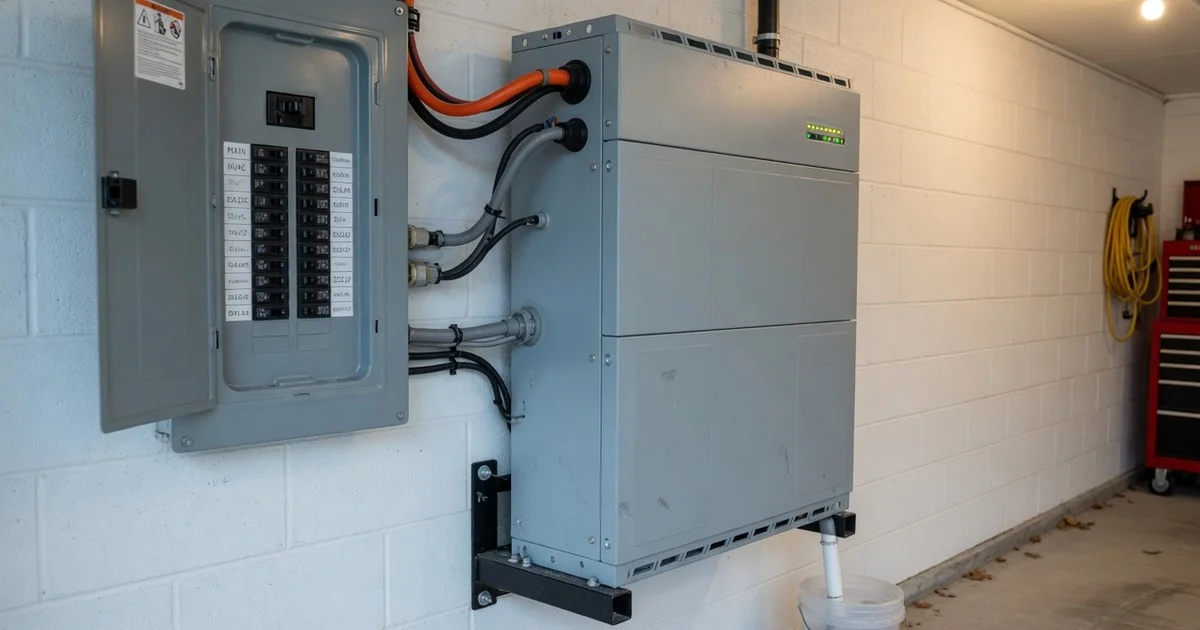
Outdoor batteries have clearances and code rules. Indoor utility rooms have heat limits. Measure the wall before you fall in love with a brochure photo. A perfect spec sheet that cannot legally hang where you planned is not perfect.
Account hygiene
Battery apps are another login on your house. Use a unique password. Decide who has admin rights. When you move, transfer or wipe access. Resilience includes boring security habits.
Case study A: essentials backup, one module class
A couple works from home and cares about fridge, lights, modem, and a CPAP. Critical load audit shows about 600-900 W typical with short pump spikes. They choose a ~13 kWh-class battery on a critical-load subpanel rather than whole-house marketing. During a six-hour outage, essentials stay up; the oven and dryer stay off by design. Cost stays far below a multi-module whole-home stack.
They rejected a quote that buried battery price inside a solar loan without a separate cash line. Separating solar cash price from storage cash price made the battery decision legible.
Case study B: Enphase roof, ecosystem wins
Existing microinverters and Enlighten monitoring already run the house. A non-Enphase battery needed extra conversion hardware and a second app. The Enphase battery package cost more per kWh but avoided a franken-system. Service calls stay with one stack. For them, ecosystem fit beat a slightly cheaper orphan battery.
Case study C: whole-home AC ambition meets physics
A homeowner wanted “the whole house including AC for two days.”. Load math showed multi-module storage plus generator planning, or a lifestyle change. They kept solar-only year one, added a modest essentials battery. Year two after living through a storm with a priority list. Ambition shrank; satisfaction rose.
Lesson:write the outage script before you buy the prop.
Case study D: two-module stack vs generator hybrid
Quote A: two battery modules, whole-home transfer, ~$18k equipment before labor, marketed as multi-day calm. Quote B: one module on critical loads (~$9k class) plus a maintained generator for multi-day storms. The family modeled three outage types from the last decade: two short evening events. One three-day ice storm. Batteries alone handled the short events; the ice storm needed fuel either way. They chose hybrid. Best home solar batteries for them meant right-sized storage plus. Honesty about long outages, not maximum kWh on a proposal.
Case study E: time-of-use arbitrage that almost paid for itself
A utility with steep evening peaks made daily cycling attractive. After twelve months of app data, the battery shifted enough kWh. To cover roughly 40% of its financing cost via rate arbitrage. The rest was insurance value for outages. They stopped expecting the battery to “pay for itself like solar”. Started booking it as partial bill tool + backup. That mental model prevented disappointment and a premature for-sale listing of used storage.
Case study F: chemistry and service radius
A slightly cheaper battery brand had no certified tech within 90 minutes. The preferred brand cost more per kWh but had two service partners in-county. During a gateway fault, swap happened in four days instead. Of a multi-week parts limbo neighbors reported on a orphan brand. For home storage, service geography is a spec, put it next to usable kWh. And continuous power rating when you compare the best solar batteries for home use.
Buyer worksheet
List critical loads with watts and hours. Circle medical or work-from-home must-haves. Choose whole-home only if load math and budget agree, not because the demo video was dramatic. Demand separate cash prices for solar and battery. Confirm who responds when the app shows a red fault at 2 a.m.
Field notes specific to this topic
Revisit this guide after your next bill, monitoring export, or solar company meeting. Write three numbers that matter forbest home solar batteries 2026: what you pay now, what a realistic system costs in your market. What success looks like in twelve months. If a salesperson cannot discuss those three without rushing you, pause. Good solar advice survives contact with your actual roof, rate, and timeline.
Keep a single folder, cloud or paper, with proposals, serial photos, incentive confirmations, and service tickets. Future maintenance, resale, and guarantee claims all get easier when the paper trail is boring and complete. That habit compounds more than any one product upsell.
FAQ
What’s the best home solar battery in 2026?
The one that matches your loads and inverter ecosystem at a fair installed price. Powerwall 3-class often leads general shortlists; Enphase fits Enphase homes.
Do I need a battery for solar to work?
No, not for basic bill reduction on a normal grid with fair export rules.
Keep reading: Batteries Hub · 100% solar? · Start Here
When you compare options on best home solar batteries 2026, insist on written exclusions, model numbers. A clear owner of grid connection follow-up. Verbal promises fade after the crew leaves. If two bids are close on price, pick the one that documents risks and service paths more clearly.
Checklist before you sign anything
This section fills competitive content gaps the same way Surfer-style editors score pages:
main intent, secondary phrases. Related entities readers (and ranking pages) expect for.best home solar batteries 2026.
Self-consumption means using solar on-site first so less energy is sold back at a weak export rate.
The inverter converts DC panel power to AC for your home. String, microinverter, and hybrid designs change service and monitoring.
When researchingbest home solar batteries 2026, compare installedcost per watt, equipment lists, and a writtenpower estimatebefore you at fancy monthly payments that hide the real price.
Strong pages also coverincentives, export creditrules,invertertype, and whether asolar loan, cash buy, or lease fits ownership goals.
Related questions people ask
- battery storage, covered in practical homeowner terms below for search clarity and completeness.
- usable capacity, covered in practical homeowner terms below for search clarity and completeness.
- backup power, covered in practical homeowner terms below for search clarity and completeness.
- depth of discharge, covered in practical homeowner terms below for search clarity and completeness.
- self-consumption, covered in practical homeowner terms below for search clarity and completeness.
- hybrid inverter, covered in practical homeowner terms below for search clarity and completeness.
- lithium iron phosphate, covered in practical homeowner terms below for search clarity and completeness.

