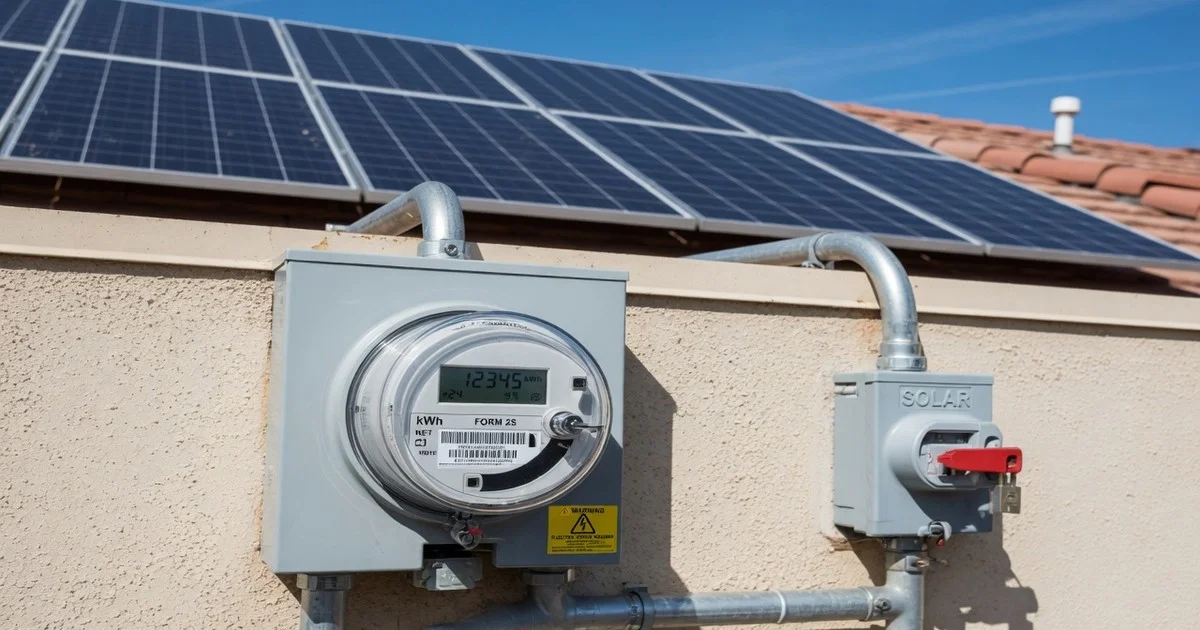
Direct answer
Net metering (and its cousins) track electricity you export to the grid and apply bill credits. True 1:1 retail-style credit is less common than marketing implies. Many utilities use net billing or lower export rates, so you buy power at one price and get credited at another. Your tariff, time-of-use periods, and fixed charges decide whether a solar quote is strong. In 2026, after residential federal credit changes, export rules often matter more than brochure production totals.
Key takeaways
- Net metering is a billing rule, not a panel brand feature.
- Retail-rate credit, net billing, and avoided-cost export are different designs with different payback.
- Time-of-use schedules can matter more than a pretty annual production estimate.
- Weak export rates raise the value of self-consumption and batteries.
- Always read the utility tariff name on your proposal, not a national blog average.
What you will get from this page
- A simple picture of import vs export on a solar bill
- Side-by-side styles: classic net metering, net billing, low export credit
- How TOU and batteries interact with export rules
- A pre-sign interconnection checklist
- Links to state cost guides, sizing, batteries, and worth-it pages
Updated July 2026. If solar sales were only about how many panels fit on a roof, every quote would look similar. The quiet variable is what your utility pays (or credits) when your house sends power out at noon and what you pay when you buy power back at 7 p.m.
Simple picture
At midday your panels may make more power than your house uses. Extra power flows out to the grid. At night, or on dark days, you buy power back. Metering and tariff rules decide how those two flows settle on the bill.
People say “net metering” as a catch-all. Utilities use more precise program names. Your job is not to win a vocabulary contest. Your job is to learn four numbers:
- What you pay for imported kWh in each time period
- What credit or rate you get for exported kWh
- Which fixed charges never go away
- Whether those rules change for new customers after a sunset date
What other explainers often miss
- Retail vs avoided-cost vs net billing language without jargon soup
- How TOU periods can make “100% offset” still leave a high bill
- Why 2026 federal credit changes make utility rules more important
- A homeowner checklist before interconnection, not only a definition paragraph
- Internal links to state cost pages where export policy actually differs
Three common designs (names vary by utility)
| Style | What you roughly get | Homeowner risk |
|---|---|---|
| Classic net metering | Export offsets usage at a strong retail-like rate | Policy can change for new applicants; grandfather rules matter |
| Net billing | You buy at retail, export at a different (often lower) rate | Oversizing panels helps less; self-use matters more |
| Low avoided-cost export | Small credit for exports | Batteries and load timing become central |
Some markets also use monthly true-up, annual true-up, non-bypassable charges, minimum bills, or export caps. Two neighbors can both “have solar credits” and still live under different math if one is grandfathered and one is on a new tariff.
Retail credit vs net billing (the confusion zone)
Retail-style net metering roughly means exported energy knocks down imported energy on a near one-for-one energy basis, subject to the fine print. It is the version many older blog posts still describe as default reality.
Net billing means the utility tracks exports and applies a monetary credit that may be lower than the retail price you pay to buy energy. You can still save a lot if you use most solar on site. You save less if you export a mountain of midday power and buy back expensive evening power.
When a salesperson says “you will be credited for everything you send to the grid,” ask: “Credited at what rate, under which tariff name, for how many years?”
Why installers and blogs talk past each other
Sales decks love annual production (kWh/year). Utilities care about when you export and under which tariff. A system that “covers 100% of annual kWh” can still leave a high bill if evening rates are steep, fixed charges are large, and export credits are weak.
This is also why two production estimates that look identical can produce different bank accounts. The missing page in many proposals is a bill simulation under your real rate, not a national average savings cartoon.
Time-of-use (TOU) interaction
TOU rates charge more at peak periods and less off-peak. Solar production often peaks mid-day. Household peaks often hit late afternoon and evening. If export credits are weak during the sunny window and import rates are high after sunset, you feel the gap.
- Strong export credits: midday surplus still has value even if you are not home
- Weak export + high evening peaks: self-use, load shifting, and batteries gain importance
- Demand charges (less common for pure residential, more common in some commercial or special rates): brief spikes can dominate; design carefully
Ask the installer for a simple hour-by-hour story: “Where does Tuesday’s solar go at 1 p.m. and what do I pay at 7 p.m.?”
Net metering vs batteries
Strong 1:1 style crediting: batteries are mostly for outages and personal preference, unless TOU or resilience still justifies them.
Weak export or high peak pricing: batteries can shift midday solar into expensive evening hours and raise the value of each panel.
Neither rule is moral. It is tariff design. Price storage with eyes open: solar battery cost 2026, backup calculator, best home batteries.
How this changes solar sizing
- Good export rates: sizing toward annual usage can still make sense if roof and panel allow
- Poor export rates: size closer to daytime self-use; do not pay top dollar for kWh you give away cheaply
- EV or heat pump arriving soon: future daytime loads can soak solar that would have exported
- HOA / main-panel limits: still cap design either way
Sizing deep dive: what size solar system do I need. Panel count helper: how many solar panels calculator.
Honest limits of “net metering will save me”
- Credits usually do not erase every fixed charge, tax, or non-bypassable fee
- Program rules for new customers can be worse than rules your neighbor got five years ago
- A blog’s state average is not your tariff PDF
- If your usage is tiny and fixed charges are high, solar bill impact can look underwhelming
- If your roof is heavily shaded, fancy billing rules will not invent sun
Worked bill sketches (teaching only)
Home A, strong export credit: Uses 900 kWh/month, exports a lot at noon while at work, imports at night. Strong credits keep the bill low even without a battery. Payback hinges more on install price and financing.
Home B, net billing with weak export: Same usage shape. Midday exports earn little. Evening imports stay expensive. Oversizing from 7 kW to 11 kW adds cost faster than it adds value. Better path: right-size, shift laundry/EV into sunny hours, consider storage if peaks hurt.
Home C, TOU + outages: Export is mediocre, evening peaks are real, and storms cut power. A moderate array plus one battery can beat a huge array with weak export and no backup, depending on prices.
State and local reality (use local pages)
California, Texas, Florida, New York, Arizona, and others do not share one net metering story. Even inside a state, investor-owned utilities, co-ops, and munis can differ. Start with local cost context, then verify your exact tariff:
- California solar cost
- Texas solar cost
- Florida solar cost
- New York solar cost
- Arizona solar cost
- USA overview
Money context after policy: worth-it guide, tax credit 2026, incentives guide.
Homeowner checklist before you sign
- Exact utility name and tariff / program name on the proposal
- Export credit rate or formula (and any sunset or step-down)
- Whether you are on net metering, net billing, or another design
- Non-bypassable charges that still appear on solar bills
- Time-of-use periods and seasonality
- Interconnection fees, timeline, and who files paperwork
- What happens if you move (agreement transfer rules)
- Whether battery export or backup modes change program eligibility
- Production estimate vs bill simulation under your rate
- Cash price and $/W without burying everything inside a monthly payment
Questions to put in writing to the installer
- “Show my export rate in cents per kWh or the exact credit formula.”
- “Is this program for new customers or a grandfathered legacy rate?”
- “What fixed charges remain if my energy charges drop?”
- “If export rules change later, what is locked for me?”
- “Model my bill with and without a battery under the same usage.”
FAQ
Does net metering mean free electricity?
No. You still face fixed charges, taxes, and rate design. Credits offset energy charges under the rules of your tariff. “Zero bill” marketing usually ignores something.
Is net metering the same in every state?
No. Some places still offer strong credits. Others moved to net billing or low export rates. Co-ops and municipal utilities can differ from big investor-owned utilities next door.
Do I need a battery if I have net metering?
Not always. Strong crediting reduces the pure bill case for storage. Outages, medical needs, and TOU peaks are separate reasons that can still justify a battery.
What is the difference between net metering and net billing?
Net metering often credits exports in a way that closely offsets usage. Net billing typically pays or credits exports at a different rate than you pay to buy power. Always confirm your utility’s actual program name and math.
Can I still benefit from solar with weak export rates?
Yes, if you use a lot of power when the sun is up, size carefully, manage loads, or add storage for expensive periods. Weak export is a design constraint, not an automatic no.
Will my credits roll over forever?
Depends on the tariff. Some programs true up monthly, some annually, some expire surplus under specific rules. Read the program documents rather than assuming infinite rollover.
Sources and method
We write for homeowners, not installers. Numbers below are planning bands from public agency pages, marketplace summaries, and common 2026 quote patterns. They are not a bid for your roof and not tax or legal advice.
- Your utility tariff PDF and interconnection documents (primary source for your address)
- State solar cost guides on Solar Power Simplified for local planning context
- NREL / DOE educational explainers on net metering and distributed solar concepts
- SPS battery, sizing, tax credit, and worth-it guides for money decisions after policy

