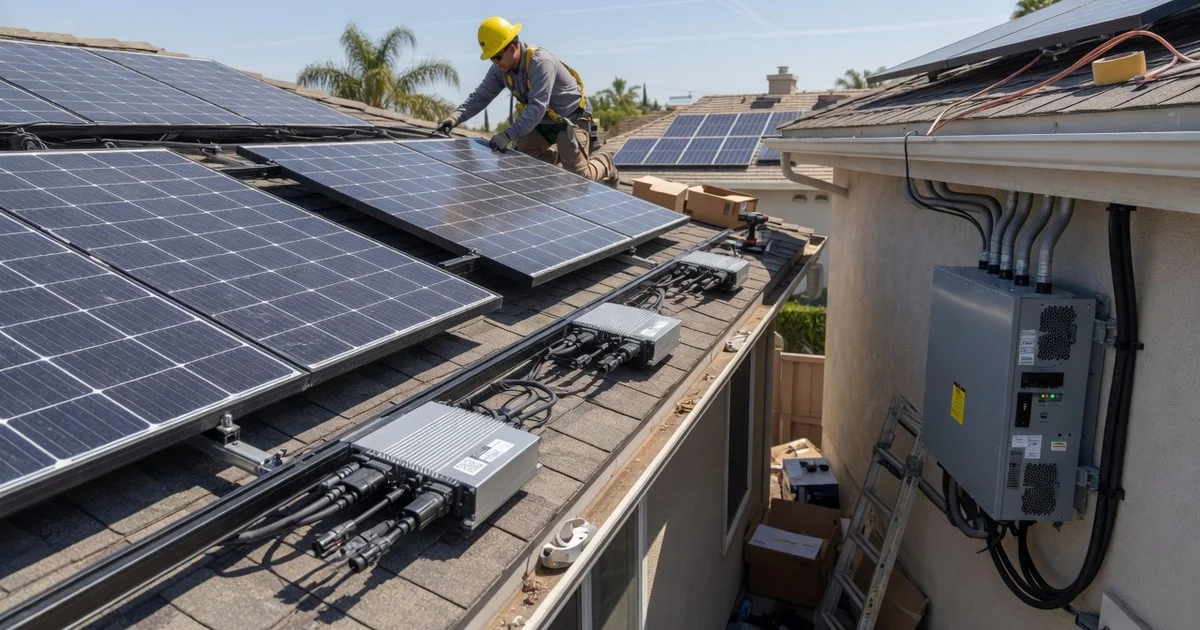
Direct answer
Choose microinverters for complex or partly shaded roofs and when you want panel-level monitoring. Choose string inverters (often with power optimizers) for simple, unshaded roofs when you want lower equipment cost and easy wall access for service. The best choice matches your roof and service plan, not a brand war on social media.
Key takeaways
- String inverters convert a series of panels; microinverters convert at each panel.
- Shade and multiple roof faces usually favor micros or optimizer-equipped designs.
- Micros often cost more upfront; strings can win on simple, sunny roofs.
- Panel-level monitoring makes troubleshooting faster after year two, not only on day one.
- Ask about rapid shutdown, warranty labor, replacement parts, and battery pairing before you sign.
What you will get from this page
- Plain definitions of string, micro, and optimizer architectures
- A side-by-side table for shade, cost, monitoring, and service
- Roof-first decision tree instead of brand slogans
- Quote traps and a practical checklist
- Links to monitoring, companies, sizing, and cost guides
Updated July 2026. Homeowners do not wake up wanting an inverter debate. They want a system that produces, survives shade from the neighbor’s tree, and does not become a mystery when one panel underperforms in year six. This page is a roof-first decision guide.
What each architecture actually does
String inverter: Panels wire in series (a “string”). DC power rides the string to a central inverter, usually on a wall, that outputs household AC.
Microinverter: A small inverter sits at each panel (or sometimes every two panels, depending on product). Conversion happens on the roof. AC wiring typically runs down to the main service.
Power optimizers: A middle path. Module-level DC optimization on the roof with a central inverter on the wall. You get much of the panel-level control without a full micro on every module.
All three can be excellent when designed well. All three can disappoint when someone forces a favorite brand onto the wrong roof.
What comparison posts often miss
- Roof-first decision tree instead of eternal brand loyalty
- Failure modes homeowners actually feel (one panel vs whole string behavior)
- Monitoring and service reality after year 5, not only install-day app screenshots
- Cost as a system choice with labor and warranty, not a meme about who “wins”
- Battery pairing questions without pretending one topology always stores better
Side-by-side
| Factor | Microinverters | String inverters | String + optimizers |
|---|---|---|---|
| Shade / mixed orientations | Usually strong | Weaker alone | Often strong |
| Upfront equipment cost | Higher | Lower on simple roofs | Mid to higher |
| Monitoring detail | Panel-level common | System-level unless added | Panel-level common |
| Expansion later | Often flexible | Must match string design | Plan required |
| Service pattern | Roof visit to swap a micro | Wall unit access often easier | Roof and wall components |
| Best fit sketch | Complex roofs, shade, detail lovers | Simple open roofs, tight budget | Shade with central inverter preference |
Roof-first decision tree
- Is the roof mostly one open, unshaded plane? String can be a clean, cost-effective design.
- Do you have dormers, chimneys, trees, multiple tilts, or east-west mixes? Lean micro or optimizer.
- Do you care about per-panel history for warranty fights and cleaning decisions? Module-level monitoring helps.
- Is access to the roof expensive or risky later? Weigh the cost of future micro swaps against today’s equipment savings.
- Is a battery likely in 1–3 years? Ask for a pairing diagram now (AC-coupled micros and hybrid string setups both exist).
- What is the all-in $/W difference for the same panel layout? If the gap is small, choose the design that fits shade and service. If the gap is huge, demand a clear production reason.
When microinverters make sense
- Dormers, valleys, chimneys, vent stacks, or partial tree shade
- Multiple roof faces that would force awkward strings
- You want per-panel production history in the app
- You may add panels in phases on different roof sections
- You value quieter behavior when one panel is dirty or shaded
Monitoring context: Enphase Enlighten monitoring review. Small-roof equipment choices also show up in best solar panels for small homes.
When string inverters make sense
- Simple south-facing (or otherwise strong) unshaded plane
- Tight budget with a clear production model and good installer support
- Easy wall access for a single inverter swap later
- Installer is standardized on a strong string package with a real track record in your county
String is not “old tech” as an insult. It is a mature architecture that still powers a huge share of good residential systems when the roof cooperates.
Optimizers: the middle conversation
If a quote says “string” but also lists optimizers on every module, do not compare it to a bare string bid as if they were identical. Optimizers add module-level electronics, monitoring detail, and cost. For shaded or mixed roofs, that package can close much of the performance gap that pure micros advertise, while keeping a central inverter on the wall.
Your comparison table should have three columns when optimizers appear: bare string, string + optimizers, and micros.
Performance claims without the hype
On clean, unshaded roofs, lifetime energy differences between well-designed systems can be modest. On messy roofs, module-level electronics can recover meaningful production that a naive string would lose. Treat “5–25% more energy” style claims as conditional, not a promise for every house.
Also separate safety features (rapid shutdown, arc-fault, listing/certifications) from marketing adjectives. Code requirements exist either way. Ask what hardware satisfies local rapid-shutdown rules on your design.
Cost and quote traps
- Comparing micros vs string without the same panel wattage and roof layout
- Ignoring optimizer add-ons that change both price and behavior
- Skipping labor warranty details for roof work
- Forgetting monitoring subscriptions or gateway hardware
- Accepting a low $/W that uses weaker production assumptions to look equal
- Never asking who stocks replacement micros or string units nearby
Use how to compare solar companies when quotes disagree. Price context: solar panel cost USA 2026.
When obsessing over inverter type is the wrong fight
- Your roof needs replacement in two years and nobody priced reinstall labor
- The main panel upgrade alone blows the budget before inverter brand matters
- Heavy shade means fewer panels or tree work should come first
- Financing APR is so high that a small equipment win cannot save the deal
- You have not checked export rules, so you might be oversizing into weak credits
Failure modes homeowners actually feel
String without module electronics: One problem panel or heavy shade on part of a string can drag production more than people expect. Central inverter faults take the tied strings down until repaired, but the wall unit is often easier to reach.
Microinverters: A single micro can fail while neighbors keep working. That is nice for partial uptime. The tradeoff is roof labor to replace the unit, especially on steep or tile roofs.
Optimizers + central inverter: Module-level issues can be isolated better than bare strings, but you still depend on the central inverter for conversion. Know both warranty clocks.
Monitoring after the honeymoon
Day-one app screenshots are easy. Year-five troubleshooting is the test. Panel-level data helps you spot a single underperforming module, a soiling pattern, or a hardware fault without guessing. System-level-only monitoring can still work if your installer is responsive and the roof is simple, but you give up detail.
Ask who owns the monitoring account, how you transfer it if you sell the house, and whether any feature needs a paid plan later.
Batteries and inverter choice
Storage can pair with multiple architectures. AC-coupled batteries work with many microinverter systems. Hybrid string inverters can DC-couple storage in other designs. Neither sentence means “always pick X if you want a battery.” It means: demand a one-page diagram showing how storage would connect, what gateway is required, and what the incremental cost looks like.
Related: solar battery cost 2026, best home batteries.
Worked roof sketches
Roof A: One open south plane, no trees, simple attic access. A quality string design can be the value winner if production estimates are honest and service is local.
Roof B: L-shaped house, two tilts, chimney shade after 2 p.m. Micros or optimizers usually deserve the premium because string mismatch risk is real.
Roof C: Small starter array now, more panels after an EV purchase. Module-level designs often expand with less redesign pain if the electrical plan anticipated growth.
Decision checklist (print this)
- How many roof faces and how many shade hours?
- Do you need panel-level monitoring?
- What is the all-in $/W difference between designs on the same layout?
- Who services roof electronics in your area, and how fast?
- What are warranty lengths for inverter electronics vs labor?
- Battery plans in writing, with a diagram?
- Rapid shutdown and code path explained in plain English?
- Replacement part lead times?
FAQ
Which is better, microinverter or string inverter?
Neither is universally better. Match the electronics to roof complexity, shade, budget, monitoring needs, and service plan.
Do microinverters always produce more power?
No. Gains show up most when panels would otherwise drag each other down because of shade, soiling differences, or mixed orientations.
Are power optimizers the same as microinverters?
No. Optimizers do module-level DC management with a central inverter. Micros convert to AC at the module. Both can offer panel-level insight, but service and system design differ.
Can I mix microinverters and string later?
Sometimes with careful design, but mixing without a plan creates support headaches. Get a future-expansion sketch in writing before you need it.
Which is cheaper to repair?
Central string inverters are often easier to reach on a wall. Micros may need roof labor for a single unit swap while the rest of the array keeps working. Price both the part and the labor path.
Does inverter type change my tax credit?
Inverter type is equipment design. Federal residential credit availability in 2026 is mainly an ownership and timing question. See solar tax credit 2026.
Sources and method
We write for homeowners, not installers. Numbers below are planning bands from public agency pages, marketplace summaries, and common 2026 quote patterns. They are not a bid for your roof and not tax or legal advice.
- NREL and industry discussions of module-level power electronics under shade (educational context)
- Installer design practice for residential strings, optimizers, and micros
- Manufacturer monitoring documentation patterns (account ownership, panel-level data)
- SPS monitoring, buyer, battery, and cost guides for homeowner checklists

